



Happy Wednesday! Today is Day 3 of our Food Relationship Reset, where we explore the theme of your food story - something you already have.
This reflection is from Part 2 of our New Year, Fresh Start Challenge, designed to help you build awareness around how you eat so healthier choices feel more natural over time. Part 2 is available to VIP members, who receive the full workbook, daily prompts, live Q&A with Diana, and complete challenge resources.
For all our subscribers, Diana is collecting your questions about nutrition, food relationships, and real-life challenges to answer during a live Q&A tomorrow, February 19 at 11am Pacific/2 pm Eastern. All submissions are confidential.
This live QA is for everyone, so submit your question below - add “WNC QA” to the subject line!
Submit your question here: wnc@hlb-health.com.
For those of you who are not yet VIP, we’ve unlocked a popular In The News post below on Protein: How Much Do You Really Need. Enjoy!

Your Food Relationship Reset Day 3: You Have a Food Story
Welcome to Day 3 of the Food Relationship Reset. Today’s reflection focuses on understanding your food story: the experiences, messages, and patterns that have shaped how you eat, think about food, and relate to your body. This step is not about blame or fixing anything; it’s about replacing shame with context, and curiosity with compassion.
When you understand why certain habits exist, they often begin to soften on their own. This awareness creates space for change that feels supportive rather than forced.
What Today’s Reflection Includes (VIP Access)
VIP members can access today’s guided workbook reflection, which includes:
A structured exploration of your personal food story
Reflection prompts to identify early influences, beliefs, and patterns
A grounding affirmation to help release self-judgment
A simple practice you can apply to everyday eating
Full access to all Part 2 Food Relationship Reset materials
This work builds directly on the reflections from Days 1 and 2, and sets the stage for one of the most impactful shifts in Week One.
Tomorrow’s reflection focuses on Releasing Food Rules - the often-unnoticed beliefs that create guilt, rigidity, or stress around eating.
This guided reflection, printable workbook, and daily prompts are available only to VIP members. Upgrade to access the Food Relationship Reset.
If you’re new to the Food Relationship Reset, so far we have covered You Have a Relationship With Food and How Do You Want Food to Feel?
Coming up in Week One: Releasing Food Rules, Relearning Hunger, and Understanding Fullness.

How Much Protein Do You Really Need?
Dr. Weil’s Take:
I believe that many people in our society are obsessed with protein, fearful of not getting enough, and never thinking about getting too much. As little as two ounces of a protein-rich food a day may be enough to prevent protein deficiency in most adults; four ounces will certainly do it. My anti-inflammatory diet calls for two to six four-ounce servings of wild Alaskan salmon, herring, sardines, or Alaskan black cod a week, along with one to two servings per week of omega-3 enriched eggs, natural cheese (one ounce equals one serving), or whole soy foods.
We need only 10 to 20 percent of calories from protein daily – that’s not much. Rather than meat, you’re better off choosing less-concentrated plant protein sources, such as beans, nuts, seeds, and whole grains. These come packaged with fiber, slow-digesting carbohydrates, healthful fats, and phytocompounds that help protect against disease.
Diana’s Take:
Protein is one of three macronutrients (alongside carbohydrates and fat), and all three, in the right balance, are essential to both survive and thrive. There’s no question that protein is important—it plays a key role in growth, repair, satiety, and even blood sugar regulation. I’m certainly not saying we should ignore protein intake or that some people may benefit from paying closer attention to their protein needs, especially athletes, pregnant and nursing mothers, and aging women.
But I can’t help but feel like the obsession with protein has maybe gone a bit too far. It seems like most of my clients are stressing over how to get 30 grams of protein at breakfast or hitting 150–200 grams a day when, in reality, they likely don’t need that much. In the pursuit of that much protein, many people find they have to rely on ultra-processed protein bars, shakes, and snacks—foods that may be high in protein but are also loaded with artificial sweeteners, additives, and other questionable ingredients.
What concerns me the most is that in our hyper-focus on protein, we’ve lost sight of other equally important nutrients - fiber being my biggest concern. While true protein deficiency is virtually unheard of in the U.S., nearly 90% of women and 97% of men aren’t eating enough fiber. Fiber is critical for gut health, digestion, microbiome health, blood sugar balance, and even longevity.
Beyond nutrient balance, I’ve seen how this fixation on protein has added unnecessary stress to people’s lives. Eating should be nourishing and enjoyable, but it’s become a numbers game for many - obsessing over protein grams, chugging shakes, and forcing down meals just to hit some arbitrary target.
At the end of the day, health isn’t about a single macronutrient. Instead of fixating on protein goals, I think we’d be better off asking: Are we eating real, whole foods? Are we getting enough fiber, healthy fats, vitamins, and minerals? A well-rounded, nutrient-dense diet truly supports long-term health, and I think it’s important that we remember that.
Protein Needs

This week’s In the News is unlocked for everyone.
Our weekly takes on trending nutrition topics are typically VIP-only - during the challenge, we’re opening access so you can experience how we break down headlines with clarity, context, and nuance. VIP members receive In The News every Wednesday, plus deeper dives, guides, and follow-up resources.
You have probably seen the push for higher protein intake lately; recommendations for 200 grams or eating 30 grams of protein at breakfast are just about everywhere, regardless of a person’s age, activity, or health status. But how much protein do we actually need? What’s the bare minimum to function properly? Can too much protein be harmful?
Let’s explore!
Protein is composed of amino acids that link together to form longer chains. It serves as the building blocks for tissues, muscles, bones, and skin. Protein is found in every cell of the body and plays a vital role in growth, development, cell repair, hormone regulation, immune function, and the facilitation of chemical reactions.
Amino acids are categorized into two main groups: essential and nonessential. Essential amino acids cannot be produced by the body and must be obtained from the foods we eat. Nonessential amino acids are equally important, but the body can synthesize them from essential amino acids or through the natural breakdown of dietary protein. The body requires nine essential amino acids and 11 nonessential amino acids.
A complete protein source contains all nine essential amino acids. These are primarily animal-based foods such as meat, fish, poultry, and dairy. In contrast, incomplete protein sources contain only some essential amino acids. These are mostly plant-based foods like vegetables, fruits, legumes, nuts, seeds, and whole grains.
However, those following plant-based diets can still easily meet their protein needs by eating a diverse diet. Since all foods contain amino acids, consuming a wide range of plant-based proteins throughout the day ensures the body gets all essential amino acids. Combining sources like legumes and grains (e.g., beans and rice, lentils and whole wheat bread, or hummus and pita) provides the full spectrum of amino acids. However, even a well-balanced vegetarian diet typically supplies sufficient protein without intentional pairing. Foods like quinoa, soy products (tofu, tempeh, edamame), and hemp seeds are also complete plant-based protein sources. It was once believed that all essential amino acids needed to be consumed in the same meal for proper protein synthesis. However, we now know this is not the case.
The Recommended Dietary Allowance (RDA) for adult protein intake is a minimum of .8g/kg. This is the amount to prevent protein deficiency; the optimal intake for most adults may be closer to 1-1.6 g/kg, depending on lifestyle. Note that this is gram per kilogram, not gram per pound.
To determine your daily protein needs and see what protein amounts are recommended for men, women, and pregnant or breastfeeding mothers, click the link below:
So what does this look like when it comes to food? Below are examples of foods that provide 64 grams of protein, the typical daily baseline for a sedentary 175-pound woman or man.
Animal-Based Protein Sources
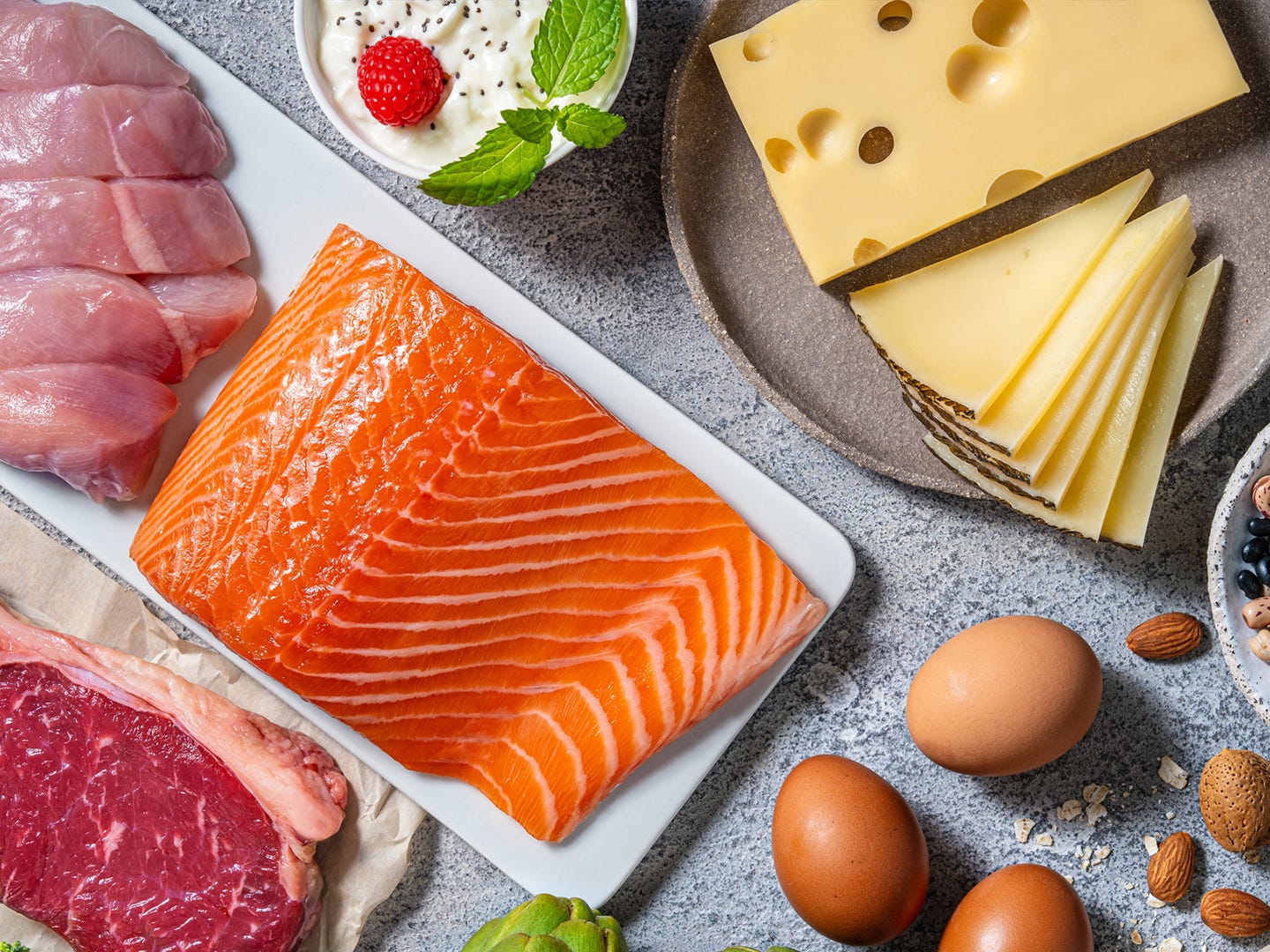
Single Foods:
8.5 oz (0.53 lbs) cooked chicken breast (~64g)
10 oz (0.62 lbs) grilled salmon (~64g)
9 whole eggs (~64g)
8 oz (0.5 lbs) lean ground beef (90% lean, cooked) (~64g)
3.5 cups (28 oz) Greek yogurt (plain, whole-fat) (~54g)
5 cups (40 oz) whole milk (~40g)
1.75 cups (14 oz) cottage cheese (whole-fat) (~40g)
Practical Combinations:
6 oz chicken breast (42g) + 2 eggs (12g) + 1 oz almonds (6g)
6 oz salmon (38g) + 1 cup cooked quinoa (8g) + 1 cup spinach (2g)
3 eggs (18g) + 1 cup Greek yogurt (16g) + 2 tbsp peanut butter (8g) + 1 oz cheese (8g)
Plant-Based Protein Sources
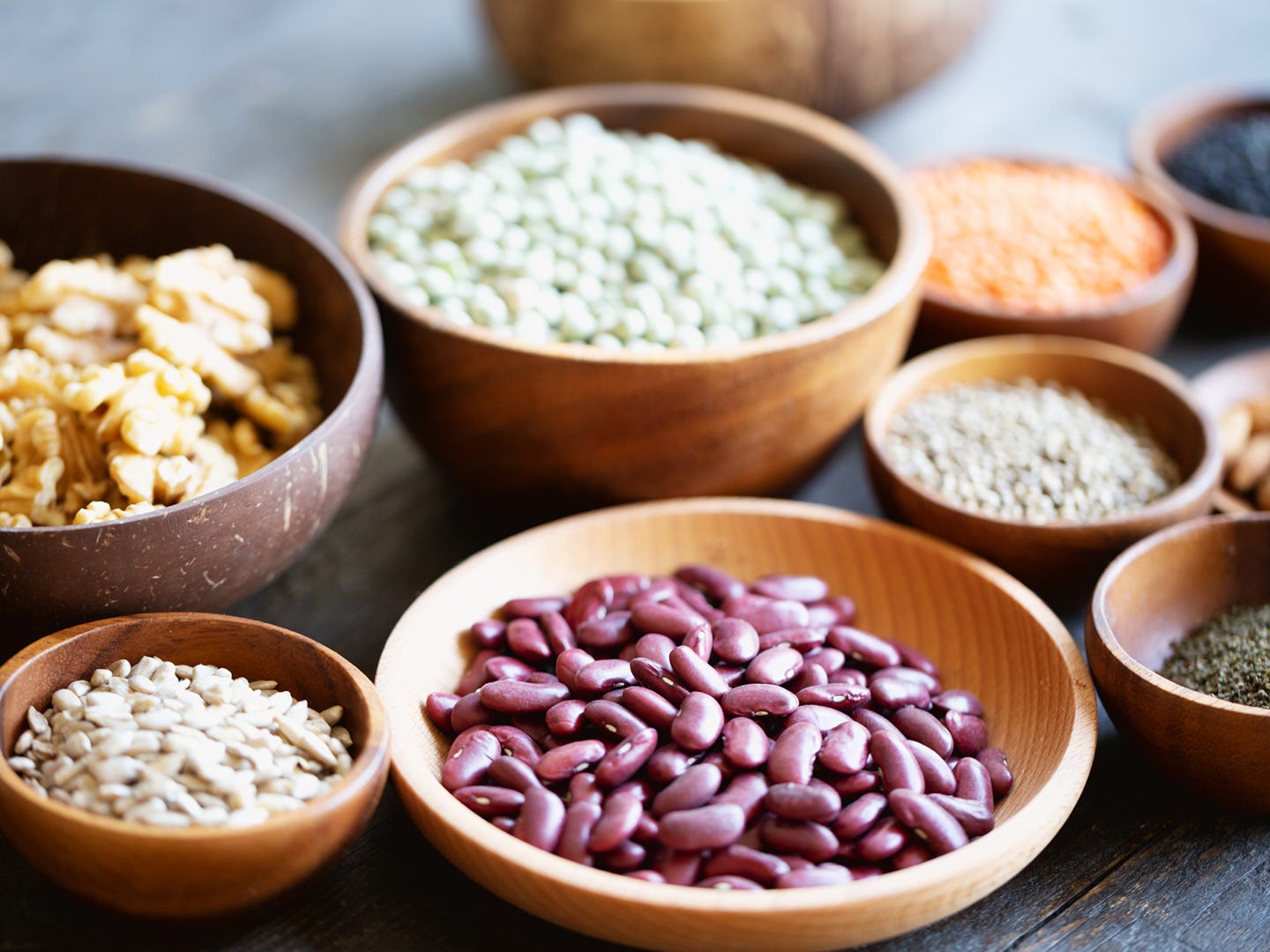
Single Foods:
2.5 cups cooked lentils (~64g)
2.75 cups cooked chickpeas (~64g)
2 blocks (14 oz) firm tofu (~64g)
2.5 cups cooked black beans (~64g)
8.5 tbsp peanut butter (~64g)
1.25 cups hemp seeds (~64g)
Practical Combinations:
1.5 cups cooked lentils (27g) + ½ block tofu (20g) + 2 tbsp peanut butter (8g)
1.5 cups black beans (30g) + 1 cup quinoa (8g) + 1 oz pumpkin seeds (8g)
1.5 cups chickpeas (32g) + 2 tbsp tahini (6g) + 1 slice whole wheat bread (5g) + 1 oz almonds (6g)
Since protein is so important, is more always better? Not necessarily. Even though protein has such a high status in our society, there’s likely no advantage to eating more of it than needed, with a particular risk from eating more than 2 grams/kg of body weight. If you eat more protein than your body needs to repair and maintain tissues, it will be “burned” as fuel. But that puts a higher workload on the body than the metabolism of carbohydrates and fats. In addition, protein is not as “clean burning” as carbohydrates and fats. It leaves residues of nitrogen-containing compounds that must be processed by the liver and removed by the kidneys. Over time, high-protein diets increase the risk of kidney damage. They can also lead to a variety of digestive issues, in part because high protein intake often goes along with low fiber consumption.
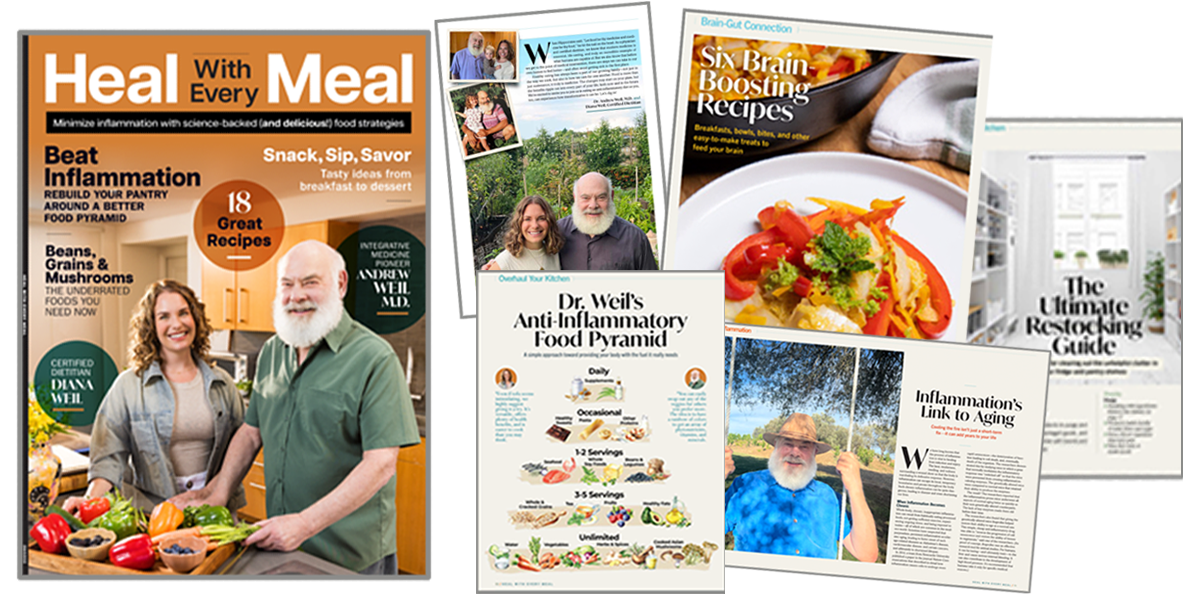
Heal With Every Meal Available Now!
For decades, we have both considered food to be one of our most powerful tools for reducing inflammation and supporting healthy aging. We are proud to share Heal With Every Meal, an essential guide to anti-inflammatory eating that we created together. Within it we bring science-backed nutrition to life with practical pantry rebuilds, kitchen guidance, and delicious anti-inflammatory recipes. Whether you’re just beginning or refining your approach, this 100-page keepsake magazine offers clear, approachable tools to help you feel better - one meal at a time.
Available now wherever magazines are sold - and online.
Such a good, balanced exposition. Thanks.
I know I have read that individuals over 65 should up the amount of protein in their diet. Is that still thought to be true?