



Happy Wednesday! Today, we are taking a look at kombucha, a rare drink you could only find in specialty healthy food stores, which is now seemingly everywhere. See what we both think about kombucha and whether its health benefits are real - plus some alternatives to try.
Diana is also sharing her opinion on what to look out for with your water during pregnancy. Read this post over in the Nourished Mama Collective and join the conversation about pregnancy and water!
We want to know: Do you drink beverages that are purported to have health benefits? Share in the comments!
(P.S. Become a paid subscriber to join the full conversation.)

Water and Pregnancy
Drinking water isn’t actually a straightforward topic, surprisingly, and there can be many factors to consider, such as budget, space, and environment.
I’ve always been picky about the taste of my drinking water, so I’ve long been filtering it, mostly to remove the chlorine taste from tap water. But when I found out I was pregnant, I started paying closer attention to environmental exposures.
That said, I do want to emphasize that this is one of those “above and beyond” things. There’s already so much pressure during pregnancy, and for most of us, tap water is perfectly safe. Even if your water quality isn’t ideal, it’s unlikely to cause any real harm to you or your baby. If this topic causes more stress than peace of mind, feel free to let it go.
My biggest advice, whether pregnant or not, is to avoid drinking from plastic water bottles. Plastic can leach chemicals, especially when exposed to heat.
When I was pregnant, I did upgrade my filtration system (though only slightly). I switched from a Brita filter to a PUR filter, which is more effective at reducing heavy metals and certain chemicals. While these smaller filters are better than nothing, many only remove about 60-70% of PFAs (forever chemicals).

Ideally, I would have opted for a reverse osmosis filter, but since we live in a small space, a large countertop or under-sink system wasn’t practical for us.
The more I learn about PFAS, the more concerned I’ve become. They are now being detected everywhere, especially in our drinking water, and, alarmingly, in every placenta tested in one study. Because of this, I switched from the PUR filter to the Brondell Coral three-stage under-sink filter, which removes more PFAS than the PUR and fits compactly under our sink.
Distilled and reverse osmosis are the most effective, though they can be expensive and waste some water (not ideal if you live in a dry climate). Some say distilled or reverse osmosis water isn’t healthy because minerals and electrolytes have been removed, but that’s actually not true. We get our minerals and electrolytes from food, not water.
You can also test your home’s water for contaminants like lead and arsenic using an at-home kit if you’re concerned, and go from there.
Is drinking water something you thought about in pregnancy? What’s your water filtration system? Join the conversation when you read this post over in the Nourished Mama Collective!

Kombucha: Worth It?
Dr. Weil's Take:
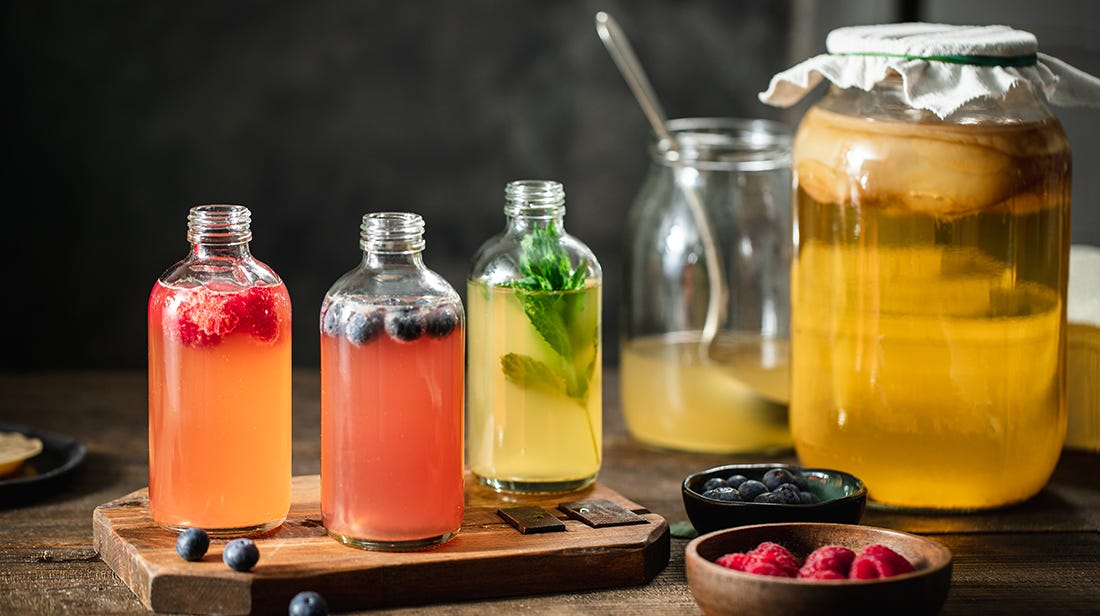
I know that kombucha has become a staple in many health-conscious circles. It’s a fizzy, tangy tea often promoted as a natural source of energy and probiotics. It’s made by fermenting sweetened black or green tea with a symbiotic culture of bacteria and yeast, known as a SCOBY. This “living” culture transforms sugar into acids, carbon dioxide, and trace amounts of alcohol, resulting in a beverage that’s lightly effervescent and somewhat tart.
While kombucha is often touted for its purported health benefits, including improved digestion, immune support, and detoxification, there is no solid scientific evidence in humans to support these claims. Some studies suggest kombucha may have antioxidant and antimicrobial properties, but more human studies are needed to feel confident in these claims.