


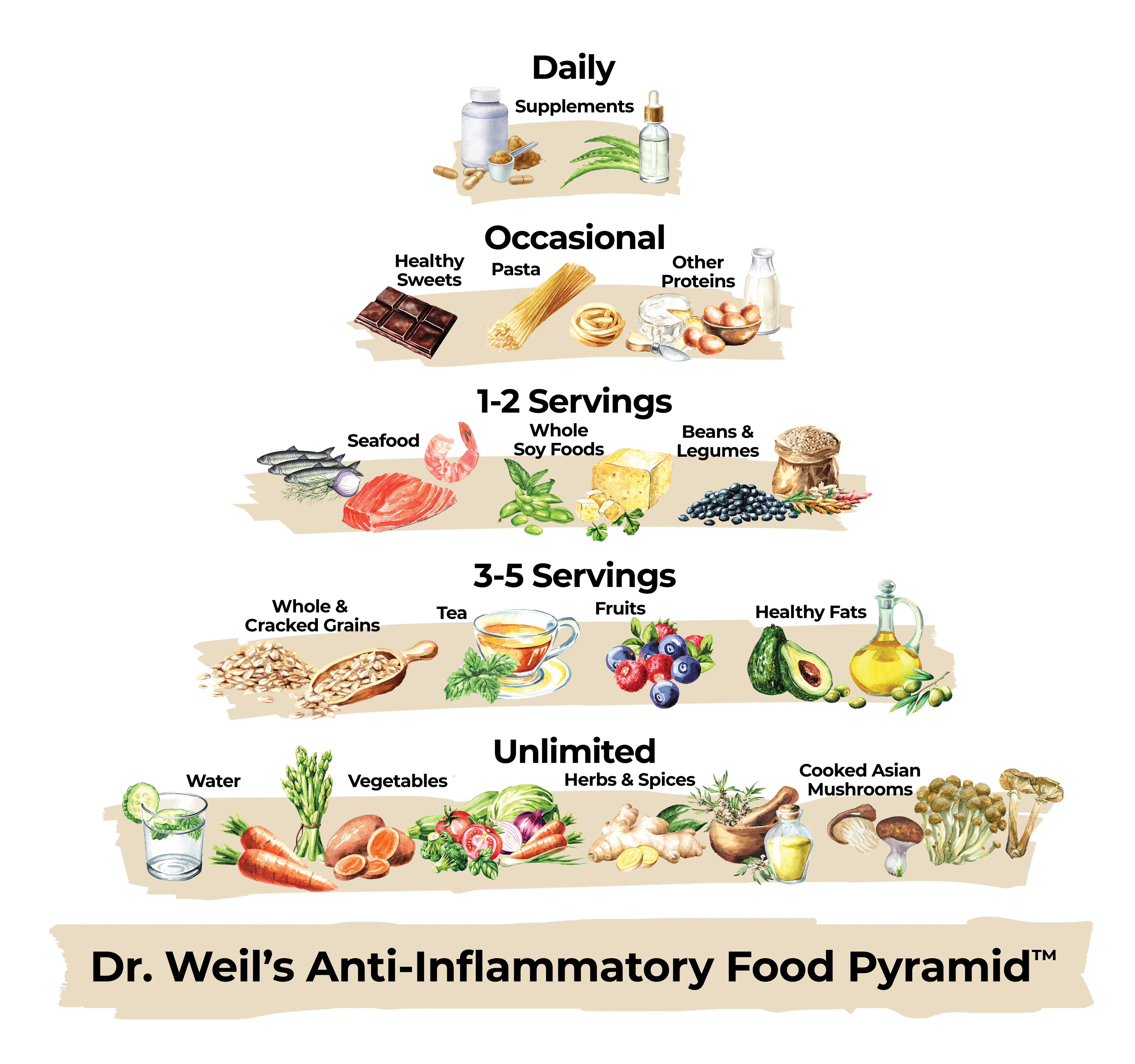
Dr. Weil’s Anti-Inflammatory Food Pyramid
We are thrilled to share our modern redesign of Dr. Weil’s Anti-Inflammatory Food Pyramid with our Weil Nutrition Corner™ readers! This is the first major update to the pyramid in 20 years, commemorating two decades since the pyramid’s original release.
Recognized by U.S. News & World Report as one of the “Best Diets” for three consecutive years, Dr. Weil’s Anti-Inflammatory Diet remains a trusted framework for long-term health.
The updated pyramid presents the principles of the Anti-Inflammatory Diet in a cleaner, more intuitive format with simplified tiers and illustrations, making anti-inflammatory eating easier to understand and apply.
“The anti-inflammatory diet has always been about simplicity - choosing foods that support health, balance and longevity. It was never meant to be a short-term or weight-loss plan, but a lifelong way of eating grounded in science. We wanted this updated pyramid to reflect that same clarity. It’s visually intuitive, easy to follow and aligned with how people learn and live today.” - Dr. Weil
“This redesign bridges generations - honoring the foundation my father created while presenting it in a way that feels fresh and practical for today’s readers.” - Diana Weil
Dr. Weil has refreshed the way we think about a healthy food pyramid. Used as a tool for a lifestyle built on balance, flavor, and longevity rather than focusing on restriction or short-term goals, this approach encourages mindful nourishment with foods that help quiet the body’s internal fire.
Drawing inspiration from both Mediterranean and Asian traditions, Dr. Weil’s philosophy highlights vibrant produce, omega-rich fish, aromatic spices, and heart-healthy fats. The result is a way of eating that not only supports energy, mood, and immunity but also makes every meal a celebration of health and taste.
Dr. Weil’s Anti-Inflammatory Diet remains a trusted framework for supporting long-term health. The refreshed pyramid translates these principles into a cleaner, more intuitive format with simplified tiers and illustrations, making anti-inflammatory eating more accessible to today’s consumers.Read on for what specifics on amounts and foods included in the pyramid.
The updated pyramid is designed to make healthy eating simple, flexible, and intuitive. We’ve visually consolidated the original 16 food groups into five clear tiers (Daily, Occasionally, 1-2 servings per day, 3-5 servings per day, and Unlimited), so you can quickly see what to emphasize in your diet.
Use the pyramid as a practical guide for building meals, planning your week, and making everyday food choices that support long-term health and reduce inflammation.
Below are specifics for each recommendation in the pyramid - enjoy!
Unlimited
Water
How much: Unlimited
Healthy choices: Drink pure water, or drinks that are mostly water (tea, very diluted fruit juice, sparkling water with lemon) throughout the day.
Why: Water is vital for overall functioning of the body.
Vegetables
How much: Unlimited (one serving is equal to 2 cups salad greens or ½ cup vegetables cooked, raw, or juiced)
Healthy choices: Lightly cooked dark leafy greens (spinach, collard greens, kale, Swiss chard), cruciferous vegetables (broccoli, cabbage, Brussels sprouts, kale, bok choy and cauliflower), carrots, beets, onions, peas, squashes, sea vegetables and washed raw salad greens
Why: Vegetables are rich in flavonoids and carotenoids with both antioxidant and anti-inflammatory activity. Go for a wide range of colors, eat them both raw and cooked, and choose organic when possible.
Herbs and Spices
How much: Unlimited
Healthy choices: Turmeric, curry powder (which contains turmeric), ginger and garlic (dried and fresh), chili peppers, basil, cinnamon, rosemary, thyme
Why: Use these herbs and spices generously to season foods. Turmeric and ginger are powerful natural anti-inflammatory agents.
Cooked Asian Mushrooms
How much: Unlimited
Healthy choices: Shiitake, enokitake, maitake, oyster mushrooms, lion’s mane (and wild mushrooms if available)
Why: These mushrooms contain compounds that enhance immune function. Never eat mushrooms raw, and minimize consumption of common commercial button mushrooms (including cremini and Portobello).
3-5 Servings Per Day
Whole and Cracked Grains
How much: 3 to 5 servings (one serving is equal to about ½ cup of cooked grains)
Healthy choices: Brown rice, basmati rice, wild rice, buckwheat groats, barley, quinoa, steel-cut oats
Why: Whole grains digest slowly, reducing frequency of spikes in blood sugar that promote inflammation. Whole grains mean grains that are intact or in a few large pieces, not whole-wheat bread or other products made from flour.
Tea
How much: 3 to 5 servings
Healthy choices: Green, matcha, oolong teas
Why: Tea is rich in catechins, antioxidant compounds that reduce inflammation. Purchase high-quality tea and learn how to brew it correctly for maximum taste and health benefits.
Fruits
How much: 3 to 5 servings (one serving is equal to 1 medium-sized piece of fruit, ½ cup chopped fruit, ½ cup of dried fruit). Avoid fruit juice, which has a high glycemic load.
Healthy choices: Raspberries, blueberries, strawberries, peaches, nectarines, oranges, pink grapefruit, red grapes, plums, pomegranates, blackberries, cherries, apples, and pears - all lower in glycemic load than most tropical fruits
Why: Fruits are rich in flavonoids and carotenoids with both antioxidant and anti-inflammatory activity. Go for a wide range of colors, choose fruit that is fresh in season or frozen, and buy organic when possible.
Healthy Fats
How much: 3 to 5 servings (one serving is equal to 1 teaspoon of oil, 2 walnuts, 1 tablespoon of flaxseed, 1 ounce of avocado)
Healthy choices: For cooking, use extra-virgin olive oil and avocado or algae oil. Other sources of healthy fats include nuts (especially walnuts), avocados, and seeds, including hemp seeds and freshly ground flaxseed. Omega-3 fats are also found in cold-water fish, omega-3 enriched eggs, and whole-soy foods. Walnut and hazelnut oils may be used in salads, and dark-roasted sesame oil as a flavoring for soups and stir-fries.
Why: Healthy fats are those rich in either monounsaturated or omega-3 fats. Extra-virgin olive oil is rich in polyphenols, which have antioxidant activity.
1-2 Servings Per Day
Seafood
How much: 1 to 2 servings (one serving is equal to 4 ounces of fish or seafood)
Healthy choices: Wild Alaskan salmon (especially sockeye), herring, sardines, and black cod (sablefish)
Why: These fish are rich in omega-3 fats, which are strongly anti-inflammatory. If you choose not to eat fish, take a molecularly distilled fish-oil supplement that provides both EPA and DHA in a dose of 2 to 3 grams per day.
Whole Soy Foods
How much: 1 to 2 servings (one serving is equal to ½ cup tofu or tempeh, 1 cup soy milk, ½ cup cooked edamame, or 1 ounce of soynuts)
Healthy choices: Tofu, tempeh, edamame, soynuts, soymilk
Why: Soy foods contain isoflavones that have antioxidant activity and are protective against cancer. Choose whole-soy foods over fractionated foods like isolated soy-protein powders and imitation meats made with soy isolate.
Beans and Legumes
How much: 1 to 2 servings (one serving is equal to ½ cup of cooked beans or legumes)
Healthy choices: Beans like Anasazi, adzuki, and black, as well as chickpeas, black-eyed peas, and lentils
Why: Beans are rich in folic acid, magnesium, potassium, and soluble fiber. They are a low-glycemic-load food. Eat them well-cooked, either whole or pureed into spreads like hummus.
Occasional
Healthy Sweets
How much: Occasional
Healthy choices: Unsweetened dried fruit, dark chocolate, fruit sorbet
Why: Dark chocolate provides polyphenols with antioxidant activity. Choose dark chocolate with at least 70 percent pure cacao and have an ounce a few times a week. Fruit sorbet is a better option than other frozen desserts.
Pasta (al Dente)
How much: Occasional (one serving is equal to about ½ cup cooked pasta)
Healthy choices: Organic pasta, rice noodles, bean-thread noodles, and part whole-wheat and buckwheat noodles like Japanese udon and soba
Why: Pasta cooked al dente (when it has “tooth” to it) has a lower glycemic index than fully cooked pasta. Low-glycemic-load carbohydrates should be the bulk of your carbohydrate intake to help minimize spikes in blood glucose levels.
Other Sources of Protein
How much: Occasional (one portion is equal to 1 ounce of cheese, one 8-ounce serving of dairy, 1 egg.
Healthy choices: High-quality full-fat natural cheese and yogurt, organic, omega-3 enriched eggs.
Why: In general, try to reduce consumption of animal foods. Use organic dairy products moderately, primarily whole-milk yogurt and natural cheeses such as Emmental (Swiss), Jarlsberg, and true Parmesan. If you eat eggs, choose omega-3-enriched eggs (from hens that are fed a flax-meal-enriched diet) or organic eggs from free-range chickens.
“If you choose to drink, I think occasional red wine is OK.” - Dr. Weil
Daily
Supplements
How much: Daily
Healthy choices: High quality multivitamin/multimineral that includes key antioxidants (vitamin C, vitamin E, mixed carotenoids, and selenium); coenzyme Q10; 2 to 3 grams of a molecularly distilled fish oil; 2,000 IU of vitamin D3
Why: Supplements help fill gaps in your diet when you are unable to get your daily requirement of micronutrients.
Instead of selenium supplements, why not one Brazil nut daily?
Just looking at this pyramid made me feel bloated and inflamed. What about those of us that cannot eat plants and instead thrive on the ultimate anti-inflammatory diet that is low-carb carnivore?